We live in a world where technology advances rapidly, spreading ideas, products, and services faster than ever before. Political and market changes that may seem distant can have a significant impact on one’s own business. In such an environment, strategic work is more crucial than ever. In the article series “Mastering Strategy” we delve into the challenges related to strategic work and explore what defines a successful strategic process. In this section, we’ll take a closer look at who should be involved from management, and how to ensure good engagement.
Who should be involved in the strategy work?
There are several levels in the organisation that (should) be involved in strategy work: the board, the CEO, the executive management team and the strategy team.
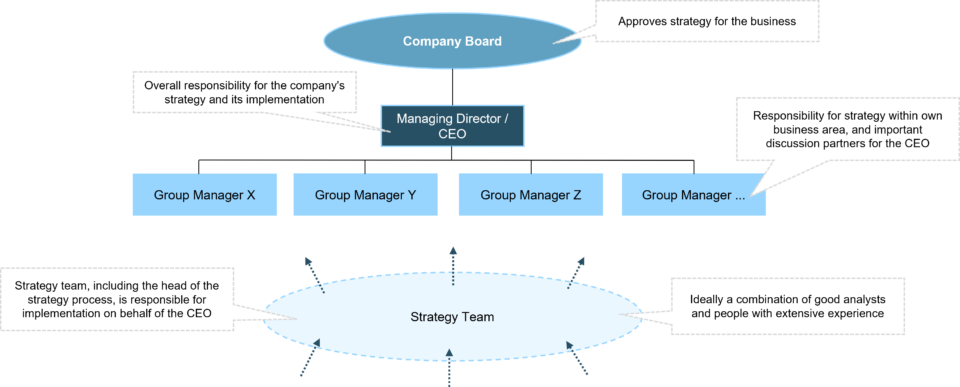
The board is responsible for determining the strategy of the organisation. The ever-increasing complexity of the world around us, which companies face, increases the demands on the board’s expertise. We have conducted company interviews that support the view that boards of an increasing number of companies want to be more actively involved in the strategy process than they have been in the past. Board members often have valuable expertise from industries and disciplines other than administration and can increasingly contribute to the strategy process.
The CEO is the most important person in the development of a new strategy. It is important that the CEO is visible and actively involved to keep the pace of discussions and processes. One of the most important elements in making the strategy process robust is that decisions are implemented. If an organisation is to succeed, it is essential that the CEO is clear that the decisions made as a result of the strategy process must be implemented. If the CEO is too distant from the strategy process, or if it is not clear that the strategy will be implemented, the process loses its legitimacy and quickly becomes a desk job with little relevance to the organisation’s development. The other members of the executive team are responsible for their own areas, and without a clear CEO, special interests can quickly take precedence over the whole, even though the other managers also have a responsibility for the whole.
The group managers are important discussion partners for the CEO, in addition to being responsible for maintaining an overview of strategies and challenges related to their own business areas. They are also responsible for leading discussions within their own management teams. The members of an executive management team have experience and expertise that provide valuable insight into the issues being discussed and play an important role in advising the CEO on what should be done. Active participation is also a prerequisite for buy-in to strategic decisions. And support is critical to ownership and commitment to implementing the strategic decisions.
The strategy team, led by the strategy process leader, is responsible for implementing the process on behalf of the CEO. The composition of the strategy team and the involvement of all levels depends on the nature of the strategy work. Our experience, supported by interviews, is that a combination of good, preferably younger, analysts and people with long experience and high credibility in the organisation is needed. It is also important that members of the strategy team have good questioning skills and the ability to challenge in a way that does not irritate but stimulates.
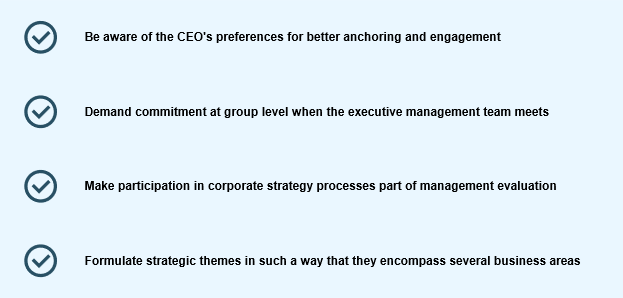
Awareness of the CEO’s preferences, expectation management and cross-cutting strategic issues ensure management commitment.
In our experience, the experience and preferences of the CEO quickly influence how strategy processes are implemented, and CEOs have very different leadership styles. Some CEOs are able to set goals and ambitions for the company almost entirely on their own, while others are keen to involve the executive team and the wider organisation. Some CEOs are general managers with a focus on the ‘day-to-day’, while others have a more strategic approach. Some emphasise the rigour of analysis in their work, while others are quick to make decisions and ‘action oriented’. Some want to be heavily involved in the process, while others are happy to just look at the results and provide guidance where necessary. It is therefore important to identify a CEO’s preferences in order to structure a process that he or she will implement and support.
A group manager has been given his or her position because he or she has delivered good results within his or her business area. It is the results in their own business area that are the measure of success. Incentives, and perhaps a relative lack of knowledge about other parts of the organisation, mean that a group manager may not feel qualified or comfortable discussing matters that affect other business areas. It can often seem as if there is a tacit agreement not to interfere in each other’s areas of responsibility. There may also be other factors that prevent good engagement in a management team, for example, relationship problems between individual managers can make discussions difficult.
That’s why it’s important to organise the work in a way that increases the likelihood of good commitment from the management team. For example, by making it clear from the CEO that commitment is expected at group level: “The moment a group of managing directors meet, each individual manager must put on their ‘group hat’ and think holistically. This should be a clear and unambiguous selection criterion for the CEO when deciding who is able to participate in the executive management team. Such involvement in corporate strategy processes should also be considered as an important part of management evaluation.
In addition, it may be useful to formulate strategic issues in such a way that they cut across several business areas, so that two or more groups managers bring the issue to the table. In this way, the issues become important and relevant to more people, and objections that not everyone who should have been involved in preparing the documentation has been involved are weakened. If only one group manager presents a case, it often becomes a defence rather than a discussion of implications and opportunities. The fact that more people raise an issue also helps to improve judgement and the robustness of assessments by ensuring a greater degree of checks and balances between different considerations.
In the next part of the article series “Mastering Strategy”, we will take a closer look at the part of the implementation that deals with strategic discussion, reasons why it can be difficult, and tips on how to be more successful in strategy discussions.
Read also:
Mastering Strategy 1: Five strategy development pitfalls
Mastering Strategy 2: Strategy work is best conducted in a cycle
Mastering Strategy 3: What determines whether you need a strategy process?
Mastering Strategy 4: How to choose the right strategy process for your organisation?