We live in a world where technology advances rapidly, spreading ideas, products, and services faster than ever before. Political and market changes that may seem distant can have a significant impact on one’s own business. In such an environment, strategic work is more crucial than ever. In the article series “Mastering Strategy”, we delve into the challenges related to strategic work and explore what defines a successful strategic process. In this segment, we take a closer look at different drivers for initiating a strategy process and how to determine what kind of process you need.
There are many possible reasons for starting a strategy process
The calendar: Many companies initiate a strategy process sometime in the first half of the year. This allows the strategy to be decided in the summer before the company starts long-term planning and budgeting in the autumn. Starting a strategy process with the calendar as the main reason is unfortunate over time. There is a risk that the process will have an unclear purpose, lack sufficient energy and fall into all the pitfalls outlined previously. Calendar-driven strategy processes are probably the main reason why many strategy processes get a bad reputation, why strategies are called unrealistic and why strategy documents end up in the bottom drawer. In other words, it is often right to ask why a strategy process is needed!
Leadership change: When there is a change in leadership it is also common to carry out a thorough strategy process to set a new strategic direction. The reason for this is that the new leader wants to gain confidence in where the company stands, set a new course and make changes to the management team – often within what is known as ‘the first 100 days’.
Events: Events, often in the form of external, dramatic developments, can also trigger a strategy process. It could be a global pandemic that sends shock waves through the stock market. It could be Russia’s attack on Ukraine and the cut-off of gas supplies to Europe, leading to an energy crisis in the EU and record high energy prices. Or it could be an understanding of the implications of the Paris Agreement for the pricing of emissions and the investment portfolio going forward. Perhaps the owner decides not to invest the capital that was previously decided. Assumptions are just as important: they often take the form of thoughts that something is unclear, that a development has begun whose consequences are difficult to understand. The rapid decline in the cost of wind and solar power, the electrification of transport and the digitalisation of value chains are examples of such developments.
Strategic control can help you determine if and what kind of strategy process your organisation needs
Strategic control, or audit as many call it, helps you define whether a strategy process should be initiated and, if so, what the purpose of the strategy process should be. It is part of the strategic cycle we have described (insert link). The purpose of strategic control is to clarify the current situation and management’s expectations for the future in relation to the goals set for the organisation.
A strategic review raises two fundamental questions based on an organisation’s knowledge of its own performance and future prospects in the light of developments in the outside world that are continuously identified through strategic monitoring:
- Is the organisation meeting its objectives today?
- Will the organisation meet its objectives tomorrow?
In order to conduct a strategic review, it is important to clarify what is perceived as ‘fit for purpose’, including the expectations that different stakeholders have of the organisation. Achieving objectives varies across industries and types of organisations. For commercial organisations, goal achievement is primarily linked to value creation, where value creation > price > cost. The objectives for the business are set by the owners through ownership reports, shareholder agreements and the company’s articles of association. For other companies, such as state-owned enterprises, it is important to fulfil a social mission. The social mission must be fulfilled as cost-effectively as possible. In many companies, for example in the energy industry, the achievement of objectives may be linked to financial targets set by the owners, while at the same time the company must fulfil a social mission that is not so easily measured in monetary terms. Balancing these different, sometimes conflicting, objectives can be challenging for a management team.
The answers to the two control questions about whether a business is fit for purpose now and/or in the future help you to form a hypothesis about the strategic challenges facing the business and the balance between improving, renewing or repositioning and reprioritising businesses.
It is important to be clear about the time horizon that will be used to assess the achievement of objectives. What is a natural time horizon to use varies between industries and organisational levels. Capital-intensive industries such as utilities and energy-intensive industries will typically have a longer time horizon than banking and finance or retail. At group level, the time horizon will also be longer than at divisional or departmental level. It is important, however, that everyone involved in discussing and assessing performance agrees on the time horizon to be used. Otherwise the discussion will be meaningless.
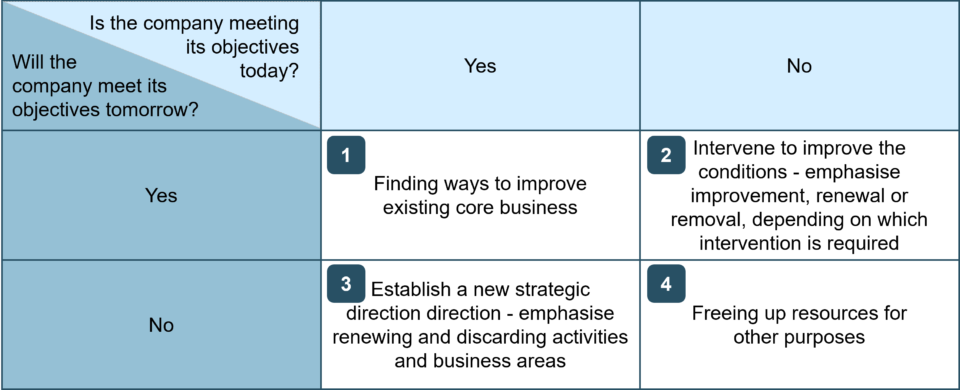
Control questions will generally be answered in one of four ways:
We live in a world where technology advances rapidly, spreading ideas, products, and services faster than ever before. Political and market changes that may seem distant can have a significant impact on one’s own business. In such an environment, strategic work is more crucial than ever. In the article series “Mastering Strategy”, we delve into the challenges related to strategic work and explore what defines a successful strategic process. In this segment, we take a closer look at different drivers for initiating a strategy process and how to determine what kind of process you need.
There are many possible reasons for starting a strategy process
The calendar: Many companies initiate a strategy process sometime in the first half of the year. This allows the strategy to be decided in the summer before the company starts long-term planning and budgeting in the autumn. Starting a strategy process with the calendar as the main reason is unfortunate over time. There is a risk that the process will have an unclear purpose, lack sufficient energy and fall into all the pitfalls outlined previously. Calendar-driven strategy processes are probably the main reason why many strategy processes get a bad reputation, why strategies are called unrealistic and why strategy documents end up in the bottom drawer. In other words, it is often right to ask why a strategy process is needed!
Leadership change: When there is a change in leadership it is also common to carry out a thorough strategy process to set a new strategic direction. The reason for this is that the new leader wants to gain confidence in where the company stands, set a new course and make changes to the management team – often within what is known as ‘the first 100 days’.
Events: Events, often in the form of external, dramatic developments, can also trigger a strategy process. It could be a global pandemic that sends shock waves through the stock market. It could be Russia’s attack on Ukraine and the cut-off of gas supplies to Europe, leading to an energy crisis in the EU and record high energy prices. Or it could be an understanding of the implications of the Paris Agreement for the pricing of emissions and the investment portfolio going forward. Perhaps the owner decides not to invest the capital that was previously decided. Assumptions are just as important: they often take the form of thoughts that something is unclear, that a development has begun whose consequences are difficult to understand. The rapid decline in the cost of wind and solar power, the electrification of transport and the digitalisation of value chains are examples of such developments.
Strategic control can help you determine if and what kind of strategy process your organisation needs
Strategic control, or audit as many call it, helps you define whether a strategy process should be initiated and, if so, what the purpose of the strategy process should be. It is part of the strategic cycle we have described (insert link). The purpose of strategic control is to clarify the current situation and management’s expectations for the future in relation to the goals set for the organisation.
A strategic review raises two fundamental questions based on an organisation’s knowledge of its own performance and future prospects in the light of developments in the outside world that are continuously identified through strategic monitoring:
• Is the organisation meeting its objectives today?
• Will the organisation meet its objectives tomorrow?
In order to conduct a strategic review, it is important to clarify what is perceived as ‘fit for purpose’, including the expectations that different stakeholders have of the organisation. Achieving objectives varies across industries and types of organisations. For commercial organisations, goal achievement is primarily linked to value creation, where value creation > price > cost. The objectives for the business are set by the owners through ownership reports, shareholder agreements and the company’s articles of association. For other companies, such as state-owned enterprises, it is important to fulfil a social mission. The social mission must be fulfilled as cost-effectively as possible. In many companies, for example in the energy industry, the achievement of objectives may be linked to financial targets set by the owners, while at the same time the company must fulfil a social mission that is not so easily measured in monetary terms. Balancing these different, sometimes conflicting, objectives can be challenging for a management team.
The answers to the two control questions about whether a business is fit for purpose now and/or in the future help you to form a hypothesis about the strategic challenges facing the business and the balance between improving, renewing or repositioning and reprioritising businesses.
It is important to be clear about the time horizon that will be used to assess the achievement of objectives. What is a natural time horizon to use varies between industries and organisational levels. Capital-intensive industries such as utilities and energy-intensive industries will typically have a longer time horizon than banking and finance or retail. At group level, the time horizon will also be longer than at divisional or departmental level. It is important, however, that everyone involved in discussing and assessing performance agrees on the time horizon to be used. Otherwise the discussion will be meaningless.
Control questions will generally be answered in one of four ways:
If the answer is 1 – find ways to improve the existing core business, it is usually about improving core processes. In this situation there is rarely a need for a strategy process. In this case, it needs to be a focused strategy process aimed at building support for improvement initiatives.
If the answer is 2, then the current strategy is valid as long as an identified problem is solved – either by adapting to external changes or by doing something internally with the organisation. An example is market fluctuations, which typically lead to organisational adjustments. In this case, it suggests that a focused strategy process is appropriate.
For answer 4 – freeing up resources for other purposes – the primary need is to run a process that provides the necessary support to do what needs to be done.
It is only in the case of answer 3 – setting a new strategic direction – that there is a need to make significant portfolio changes that require the organisation to carry out a thorough strategy process. Equinor’s decision to change its portfolio to include a larger share of renewables is the result of such a process. It puts you ahead of the game.
In our view, it makes sense to conduct strategic reviews annually, or even more frequently if your company’s “turnaround times” allow it. Most importantly, a strategic review should be conducted before you decide to embark on a comprehensive or specialised strategy process. Or find out that you don’t need a strategy process at all.
In the next part of the article series “Mastering Strategy”, we will take a closer look at the content and purpose of a focussed and comprehensive strategy process.
Read also:
Mastering Strategy 1: Five strategy development pitfalls
Mastering Strategy 2: Strategy work is best conducted in a cycle
Mastering Strategy 4: How to choose the right strategy process for your organisation?
Mastering Strategy 5: Management engagement as a success criterion