We live in a world where technology advances rapidly, spreading ideas, products, and services faster than ever before. Political and market changes that may seem distant can have a significant impact on one’s own business. In such an environment, strategic work is more crucial than ever. In the article series “Mastering Strategy”, we delve into the challenges related to strategic work and explore what defines a successful strategic process. In Part 2 of this series, we looked at how the strategy process can be divided into two main types: comprehensive (setting a new strategic direction) and focused (looking at specific business areas or issues). In this section, we take a closer look at the key elements that distinguish the pervasive strategy process from the focused one. We also discuss how the company’s needs should be clearly clarified in order to determine which type of strategy process should be undertaken.
The comprehensive strategy process clarifies the strategic direction
A comprehensive strategy process is initiated when one or more turning points have been identified and preliminary analyses indicate that these could have a major impact on the development of the company’s portfolio. The term ”comprehensive” does not necessarily refer to the number of people involved or the duration of the process, but rather to the potential importance of the decisions to be made for the strategic direction of the company.
The purpose of the comprehensive strategy process is to set a new overall strategic direction for the company, as illustrated in Figure 1. The process involves reassessing the company’s core activities and areas of focus. In general, the overall strategic direction involves deciding how the company’s resources should be allocated: either to improving existing core activities, to growth initiatives that renew the business, or to freeing up resources by discontinuing existing activities. Setting the overall strategic direction can involve major portfolio changes and should be managed from the top down.
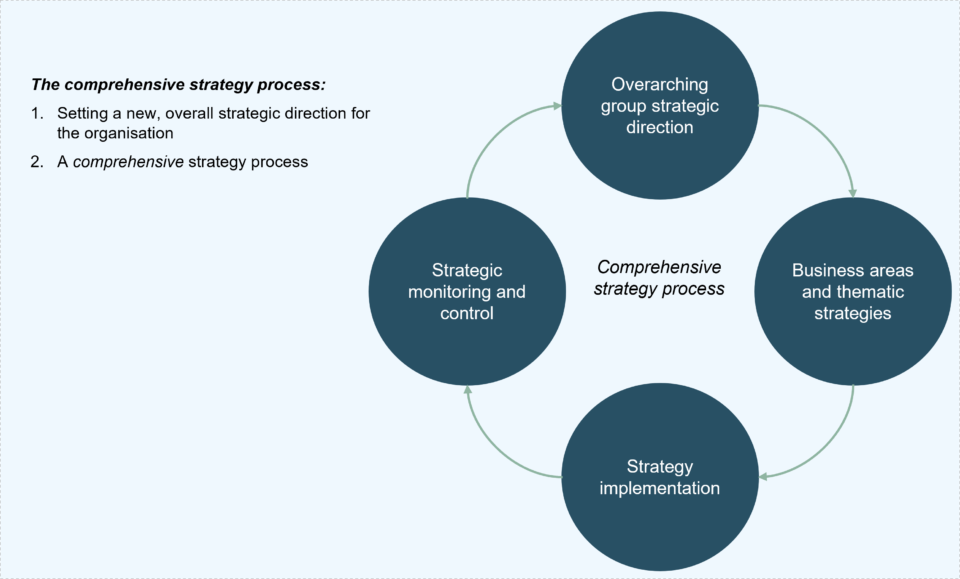
For strategy work, this means that potential turning points are brought forward for discussion by the company’s management and board. In order to set the overall strategic direction, there are some important premises that need to be considered in the discussions:
Internal conditions are those factors that the company itself can control. The company’s ability to adapt depends on the resources at its disposal, both physical and financial. The company’s financial situation (profitability, liquidity and solvency) and its ability to adapt (the number of resources available, their motivation and knowledge) determine whether the company should focus on growth or improvement. If the company has a lot of resources available, the focus should be on growth or on freeing up capital and resources for activities that generate returns. If there are few resources available, the focus should be on improving operations and possibly restructuring the company.
External conditions are technological, market and political developments in the world around us. Here the company can help to influence but not control. External conditions can be difficult to predict, which makes it harder to plan for them in strategy work. This can affect whether the company should focus on growth opportunities within its core business or whether it needs to look at other business areas. The strategic choice is about setting the direction for portfolio development.
The company’s internal and external conditions influence the balance between improvement and growth initiatives:
- Crisis situation: Where all attention is focused on efficiency and improvement, the company is in crisis, where short-term optimisation is necessary to survive.
- Turnaround: If all attention is focused on growth outside the core business, it is a sign that the business is in a turnaround, driven by the expectation that the core business will become unprofitable over time. Example: Oil and gas companies will increasingly focus on renewable energy and other new business areas.
The choice of strategy usually involves a balance between improvement initiatives and growth initiatives. The choice of balance between the two will lay the foundation for the refined strategy process, which is the next step in the strategy cycle.
The focused strategy process can serve several purposes
The focused strategy process focuses on individual business areas or issues as the basis for strategy, as shown in Figure 2. In this strategy process, the overall direction is taken for granted and the focus is on improving or developing specific areas.

The focused strategy process can have several purposes. It can be growth within the existing business or growth opportunities outside the core business. For example, these strategies may aim to
- Increase buy-in and understanding of the overall strategy
- Reduce costs within a given time frame
- Find new business areas that provide growth opportunities and contribute to portfolio diversification
The strategy process also needs to be tailored. It’s important to distinguish between work that requires the involvement of the whole organisation and work that requires fewer resources. This process can be either top-down or bottom-up. A bottom-up process for defining strategic issues often results in incremental change. The primary objective should then be to build support for the strategic direction.
Choosing the right strategy process is critical to effectively managing change and capitalising on new opportunities. Each process must be tailored to the specific situation of the organisation and its internal and external resources. Whether the strategy process should include a new overall direction before developing specific businesses and issues, or focus only on the latter, is determined by strategic monitoring and control. By carefully assessing the company’s needs and objectives, management can determine whether a comprehensive or focused strategy process is most appropriate.
In the next part of the “Mastering Strategy” series, we will take a closer look at leadership and strategy. We’ll take a closer look at who in management should be involved in the strategy process, and how to ensure good engagement and active participation by all concerned.
Read also:
Mastering Strategy 1: Five strategy development pitfalls
Mastering Strategy 2: Strategy work is best conducted in a cycle
Mastering Strategy 3: What determines whether you need a strategy process?
Mastering Strategy 5: Management engagement as a success criterion