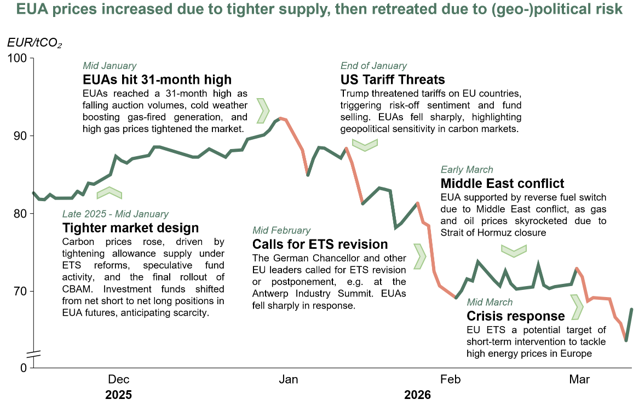
The pattern is clear: while the underlying balance of the system remains tight, price formation has become increasingly dominated by expectations of political intervention rather than purely by fundamentals.
Also more generally, abatement dynamics are shifting: The power sector has largely exhausted low cost abatement options, while industry to an increasing degree starts carrying the decarbonisation burden, but faces high costs and global competition. This creates a structural mismatch: Achieving climate targets requires higher EUA prices but maintaining industrial competitiveness requires lower and more stable prices, at least for the time being. This tension is now the defining feature of ETS development and the key driver behind the expected July 2026 reform proposals.
The review by the European Commission will define the direction of carbon prices for the next decade. The market is entering a phase of structural tightening driven by a 4.3-4.4% annual reduction in the cap, Market Stability Reserve (MSR) activity and an accelerating CBAM rollout. High energy prices, exacerbated by the EU’s carbon pricing, build political pressure for more flexibility from energy-intensive industries and fossil-fuel-dependent EU Member States. The reform process is, at the core, an outcome driven by those forces.
The EU Commission’s task is to preserve the ETS’s credibility as a long-run decarbonisation signal while addressing legitimate concerns about industrial competitiveness and energy price volatility due to the multiple ongoing crises, e.g. in Ukraine and Russia or the Middle East.
Four key reform pillars are becoming increasingly likely:
- Softer cap trajectory (Linear Reduction Factor adjustment): The current Linear Reduction Factor is increasingly viewed as too ambitious given political and economic constraints. Political pressure is building to reduce the LRF (e.g. toward ~3.4% or lower) to slow the pace of tightening and ease short-term price pressure.
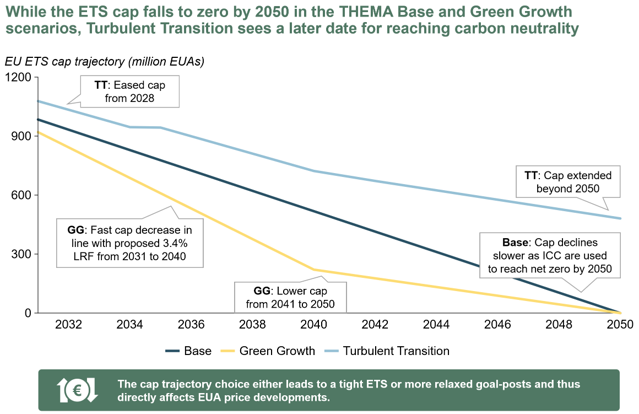
THEMA’s scenarios try to reflect the outcome space of the reform, with a prolongation of the currently 4.4% LRF after 2030 not assumed to be likely given current political discussions. Rather, our scenarios reflect cap trajectories that ease over time if hard-to-abate emissions remain expensive and the political will to decarbonise weakens over time.
2) Prolonged Free Allocation: Industrial stakeholders are pushing for a slower phase‑out or extended transition periods well beyond the current phase-out deadline by 2034, arguing that CBAM is not yet sufficiently proven to prevent carbon leakage. Representatives from Germany have floated an extension to 2039, for example. If adopted, such changes would reduce immediate carbon cost exposure for industry, but also weaken near‑term abatement incentives and potentially delay investment decisions.
The Commission’s proposed benchmark update for 2026-2030 would allow industry to continue covering approximately 75% of its verified emissions through free allocation for 2026–2030. As calls for further adjustments from companies under strain show, this might not be enough.
3) A more flexible MSR: Rather than acting primarily as a tightening mechanism, the MSR may be reformed into a more dynamic tool capable of stabilising prices, including more responsive release rules and adjustments to invalidation thresholds. In effect, this would move the ETS closer to a managed market, where supply is adjusted in response to price signals rather than being fixed ex ante.
Already in April, changes to the MSR’s functioning were presented: Under the existing framework, all MSR holdings above 400 million allowances are automatically invalidated, a mechanism that has permanently cancelled more than 3.2 billion EUAs since 2023. The Commission’s proposal ends this invalidation rule. Instead of being cancelled, surplus allowances would be retained as a strategic buffer, deployable to stabilise the market during demand shocks or scarcity events.
4) Negative emissions included? In addition, the inclusion of carbon removals into the EU ETS could perhaps be the most important reform in the longer term, as it could act as a liquidity instrument for the ETS, providing a softening of the cap and a ceiling for carbon prices. The measure would also allow hard-to-abate sectors to use alternative means to secure net zero commitments.
Besides these four central levers, the Commission is assessing whether to extend the ETS to cover municipal waste, additional maritime sectors, and greenhouse gases not currently covered. Each new sector added to the cap-and-trade mechanism creates incremental compliance demand but also brings new emission trajectories which might add to short-term decarbonisation pressure.
In parallel, talks on linking the EU and UK ETS are active, with both sides having published a statement of common understanding in May 2025, and scheduled a formal meeting over the summer 2026. However, the stepping down of PM Starmer might put the timing of these negotiations in jeopardy. Linkage would imply price convergence, with UK allowances (UKAs) currently trading at a discount to EUAs.
The July 2026 review will be a defining moment for European carbon pricing. Watch for the Commission’s proposals on MSR recalibration, scope definitions, and removal integration – they will be the main parameters for ETS price expectations through the 2030s.
Our THEMA EU ETS model helps to combine detailed policy insight with robust quantitative tools to navigate the impact of the reform. The model provides a comprehensive representation of the carbon market, including a granular depiction of supply-side dynamics such as MSR activity and allowance flows. On the demand side, we incorporate sector-specific marginal abatement cost curves for industry, maritime and aviation, while linking power sector emissions to our power market model to capture realistic abatement pathways.
This integrated approach allows us to translate complex policy reforms into clear, quantified impacts on CO₂ prices and market dynamics. For our clients, this means moving beyond uncertainty and gaining actionable insights: how different reform pathways affect price levels, volatility and long-term investment signals across sectors.