We live in a world where technology advances rapidly, spreading ideas, products, and services faster than ever before. Political and market changes that may seem distant can have a significant impact on one’s own business. In such an environment, strategic work is more crucial than ever. In the article series “Mastering Strategy”, we delve into the challenges related to strategic work and explore what defines a successful strategic process. In the final part of this series, we will take a closer look at what it takes to succeed in the challenging task of strategy implementation.
There are several reasons why strategies are not implemented as expected. There are three gaps when working with strategy that need to be closed to achieve successful implementation: the knowledge gap, the alignment gap, and the effect gap (Bungey, 2021). In this article, we will give you a better picture of what these gaps are and what can be done to close them.
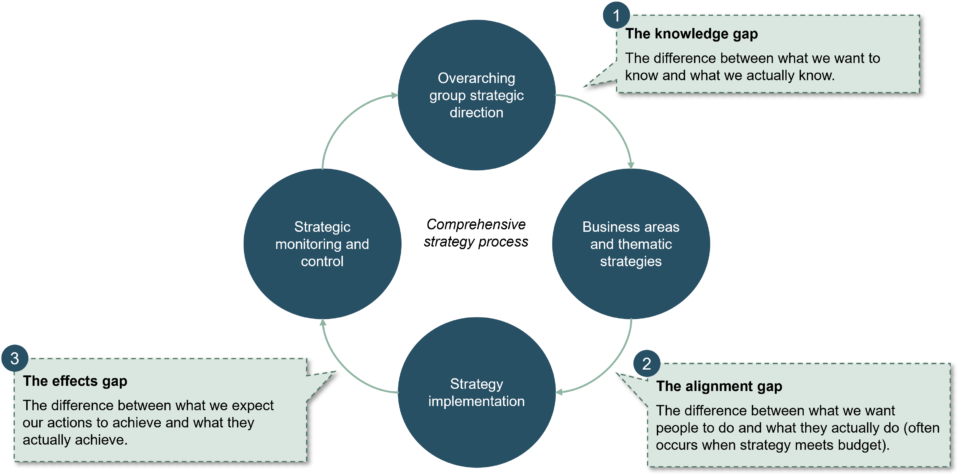
The knowledge gap stems from a lack of knowledge about developments in the outside world and internal conditions in the organisation on which we base our strategies. There is a difference between what we would like to know, or think we know, and what we actually know. And, unfortunately, we are all too seldom aware that these differences exist.
There are several reasons for this. We don’t have enough information about what’s going on, we interpret the information incorrectly, we overestimate our own capabilities (ref. decision-making bias), or we misjudge the response from key stakeholders and competitors. Last but not least, we misjudge what might happen in the future, which is fundamentally impossible to know (Kay, 2021).
The alignment gap arises when we need to get the organisation to do what we have decided. There is a difference between what we want people to do and what they actually do. This may be because the message about what they should do does not get through, it is misunderstood, or the organisation acts too soon or too late. It’s also not certain that the organisation thinks it’s a good idea, or puts it aside because it has other priorities.
The first obstacle associated with the alignment gap is usually when the budget and key performance indicators (KPIs) for the next year are set. This is when it becomes clear that other issues will have to be de-prioritised in order to deliver the strategic initiatives that have been agreed. One of two things often happens:
- New strategic initiatives are added to existing ones. And because they rarely allocate sufficient resources to the most important initiatives, resources are spread thinly across all initiatives, often resulting in slow progress and increased workloads.
- In other cases, the new strategic initiative involves increased costs or investment for a period of time before the benefits can be realised. But the performance requirements are in the next budget period. Then the short-term performance requirements win out and the initiative is postponed or scrapped.
Furthermore, when KPIs are set, they are set within existing activities and rarely on strategic initiatives. One of the reasons for this is that strategic initiatives are difficult to measure at an individual level. In addition, changes to KPIs are rarely very aggressive; after all, they are set in consultation between the manager and the employee, both of whom have a common interest in achieving the target figure. In other words, setting KPIs can mean that strategic initiatives do not get the attention they need to be effective.
Resources must match the task. If there is insufficient flexibility in the organisation, both financially and in terms of human resources, it is a managerial task to de-prioritise other tasks in order to free up resources. This is often a difficult decision to make, and it should be a goal of every organisation to have some spare capacity for strategic initiatives that arise throughout the year.
The impact gap is the difference between what we expect our actions to achieve and what the actions actually achieve. It can be the result of our actions not having the desired effect because circumstances have changed. Customers, competitors and others act on their own, outside our control and rarely as we predict. As a result, the outcomes of our actions also differ from what we expected.
When we try to close the gaps, we usually make things worse
Unfortunately, the most common response to strategy execution problems is to make things worse:
- The knowledge gap is not closed, but more bureaucracy is created.
We ask ourselves whether we know enough, whether people are doing what we say, and whether our actions are producing the desired results. We want to reduce, or preferably eliminate, the uncertainty that is perceived as uncomfortable. So we respond by asking for more detailed information to close the knowledge gap, by giving more detailed instructions to close the alignment gap, and finally by doing more checks on people to make sure we get the results we want in the future. However, this often leads to more bureaucracy, more frustration and higher costs. There is more bureaucracy because we are getting more detailed information, collecting more data, doing more analysis and building a bigger knowledge base. Then we hold more meetings, initiate more projects and slow down the pace of decision-making. And we still fail to close the knowledge gap. - The alignment gap doesn’t close, but frustration increases
By attacking the alignment gap with more detailed instructions, more work is quickly created to interpret the instructions at lower levels, and more conflicting initiatives are established. Eventually, top management has to get involved to resolve the confusion. The consequence can be that people experience less trust and no longer want to make decisions, choosing instead to push the strategy back up the system. - The effect gap does not close, but costs increase
Introducing more management systems and more detailed control of all activities and processes increases the cost of the control system and other overheads.
All in all, it is demanding and almost impossible to close the gaps because there is always friction between the actual and the ideal.
- Our plans are flawed because we lack knowledge
- Our actions don’t always turn out as planned because not everyone who needs to act agrees with the plans.
- And even when the plans are good and people do exactly what we intend, the effect is not what we want because the world is fundamentally unpredictable.
We can’t close the gaps with more analysis, more detailed instructions and more control.
To close the knowledge gap, it is better to reduce the instructions to define and communicating the purpose – an overall strategic direction.
However, the overall strategic direction must be based on an understanding of the organisation’s competitive advantages, what the organisation’s focus is based on goals, capabilities and opportunities.
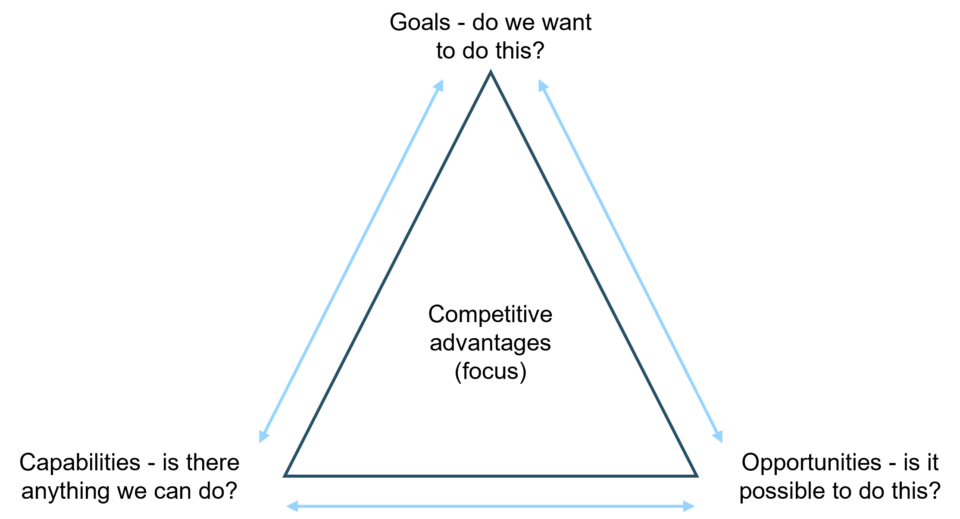
The core of an overall strategic direction should contain three points:
- A description of the situation, including the main reasons for the choice of direction: what is known, what is likely and what we do not know. Feel free to include long term goals – vision and objectives.
- A brief description of the overall purpose – strategy: Described as a task in terms of what we want to achieve and why. The task is a step towards the long term goal.
- A statement of more specific themes derived from the purpose – main strategic tasks: Issues to be addressed by the organisation. It becomes the task of the lower management level to translate this into projects to be implemented.
To close the connectivity gap, we need to allow each level of the organisation to define how it will achieve the purpose of the level above in a strategic direction. This alignment must then be checked at the level above. This avoids knowledge gaps caused by management at the lower level not knowing the necessary details, while at the same time confirming to the lower level that their actions are fulfilling the strategic objectives of the actions being taken.
It is important to make some organisational clarifications to ensure that the strategy is implemented:
- Are there organisational units that can be made responsible for carrying out the task, or does a separate project need to be set up?
- Do we have managers with sufficient experience to run the unit with sufficient autonomy and who are committed to the strategy?
- Do we have an organisational hierarchy with sufficient decision-making authority at each level to do the job?
To close the effect gap, it’s important to give individual employees the freedom to align their actions with the intention. By ensuring that everyone understands and agrees with the strategic intent (what and why), the more autonomy you can give people in how they perform their jobs.
At the same time, the executive management has the responsibility to motivate through extensive and recurring communication, employee development, leadership development and coaching to promote engagement and persistence in the execution phase.
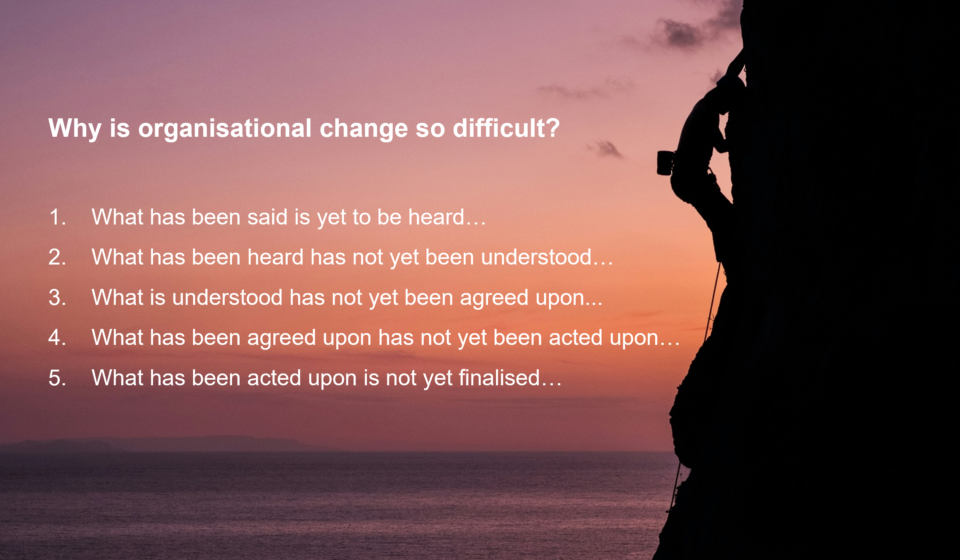
(Source: Konrad Lorenz)
Read also:
Mastering Strategy 1: Five strategy development pitfalls
Mastering Strategy 2: Strategy work is best conducted in a cycle
Mastering Strategy 3: What determines whether you need a strategy process?
Mastering Strategy 4: How to choose the right strategy process for your organisation?
Mastering Strategy 5: Management engagement as a success criterion